Free, no sign-up, works anywhere in the world
Will shade reach your solar panels?
Before you spend thousands on a system, find out what actually falls across your roof — the neighbour's second storey, the tree over the fence, your own chimney — at every hour of every day of the year.
The problem
Shade costs more than the roof it covers
People assume a shadow over a corner of the array costs a corner's worth of power. It does not. Panels are wired together in strings, and a panel that is struggling can pull down the panels wired with it.
Modern panels contain bypass diodes that limit the damage, and microinverters or DC optimisers limit it further by letting each panel work on its own. Those are worth asking your installer about if your roof has an unavoidable obstruction. But no amount of hardware turns a shaded roof into a clear one, and the cheapest fix by a wide margin is to put the panels somewhere the shadow never reaches.
That is a question about geometry, and it can be answered before anyone climbs on your roof.
The neighbour's roofline
A two-storey wall on your sunny side is the most common cause, and the one people notice last. It can also arrive later, as an extension on a house that is single storey today.
Trees, including future ones
A canopy that clears your roof today may not in ten years, and a panel array lasts twenty-five. Model the tree at the size it is heading for, not the size it is.
Your own roof
Chimneys, flues, antennas, air conditioning units and a gable that stands above the rest of the roof all cast shadows onto the very surface you were planning to cover.
Worth knowing
Check midwinter, not midsummer.
The sun sits far lower in winter, so every shadow stretches six or seven times longer. A roofline that misses your panels entirely in midsummer can cover them through the middle of a midwinter day — and winter is already when the system generates least, so those lost hours cost twice.
How it works
Three minutes, before anyone quotes you
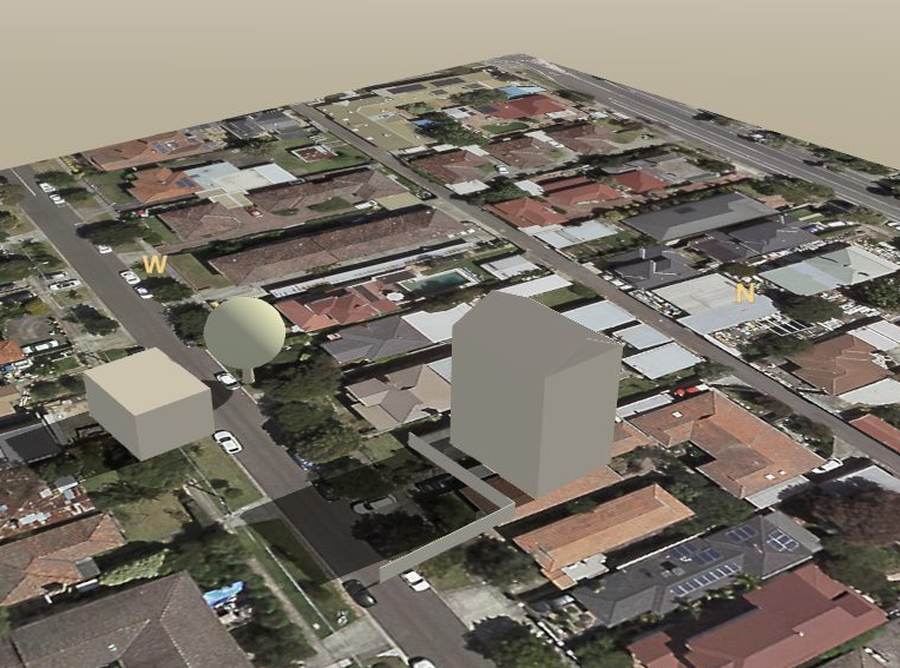
Type in your address and the planner loads an aerial photograph of your property. You trace your roof and everything around it, then scrub through the day and the year to watch the shadows move.
-
Trace your roof
Click around the outline, set the number of storeys, and choose a gable roof with its pitch if that is what you have. The ridge line matters, because one slope can shade the other early and late.
-
Add everything that could reach it
The neighbours on your sunny side, with their heights. Any tree within striking distance, at the size it will grow to. Fences rarely matter for a roof, but they are there if you need them.
-
Check the hard cases
Midwinter first, then nine in the morning and three in the afternoon. If the roof is clear at those, it is clear almost always.
What to check
The four questions worth answering
1. Is the roof clear between nine and three?
That window is where most of the day's generating happens, because it is when the sun is high enough to strike the panels near square. Shade at seven in the morning costs comparatively little. Shade at midday costs a great deal. If you check nothing else, check this.
2. Is it still clear at the winter solstice?
Around 21 June in the southern hemisphere, 21 December in the northern. This is the worst case for shadow length, and a roof that survives it survives the whole year.
3. Which part of the roof stays clear longest?
Rarely is a whole roof equally good. Watching the shadow move usually shows one face or one end holding sunlight noticeably longer, and that is where the panels want to be — a question worth settling before an installer decides it by convenience.
4. What could change?
Panels last twenty-five years. Trees grow, and single-storey neighbours sometimes become two-storey ones. Raise the tree, raise the house next door, and see whether the answer holds.
Orientation
Which way the roof faces, once shade is ruled out
In the southern hemisphere a north-facing roof collects the most over a year; in the northern hemisphere, a south-facing one. East and west faces generate less at their peak but spread output across the morning and afternoon, which suits a household that uses power at those ends of the day rather than at noon.
Tilt matters less than people expect. Something near your latitude is a reasonable year-round compromise, a shallower angle favours summer, a steeper one favours winter — and most roofs are whatever pitch the builder chose anyway.
All of which is secondary. Orientation is a question of how much, and shading is a question of whether. Settle the shading first.
Common questions
The things people ask before they get quotes.
How much does shade affect solar panels?
More than the shaded area suggests. Panels are wired together in strings, so a panel that is partly shaded can pull down the output of others wired with it. Bypass diodes inside each panel limit the damage, and microinverters or DC optimisers limit it further by letting each panel work independently. Even so, shade costs more than the fraction of roof it covers.
Which way should solar panels face?
In the southern hemisphere, north. In the northern hemisphere, south. East and west facing panels generate less at peak but spread their output across the morning and afternoon. Orientation only matters once shading is ruled out, because a shaded north face will lose to a clear east one.
What time of day matters most for solar shading?
Roughly nine in the morning to three in the afternoon, when the sun is high enough to do most of the day's generating. Shade at seven in the morning costs comparatively little. Shade at midday costs a great deal.
Why check solar shading in winter?
The sun sits far lower, so every object casts a much longer shadow. A roofline or tree that misses your panels entirely in midsummer can cover them through the middle of a midwinter day. Winter is also when your system already generates least, so losing hours then hurts twice.
Do I need to know my neighbour's exact house height?
An estimate is enough. A single-storey house is roughly three metres (ten feet) to the gutters, or four and a half to five and a half (fifteen to eighteen feet) if it sits high off the ground. A two-storey house is usually six to seven (twenty to twenty-three feet). Set a height, then move it up and down and see how much the answer changes.
Does this calculate how much power I will generate?
No, and it does not pretend to. It shows the geometry of shade: what falls where, at what hour, on what day. It does not model panel efficiency, weather or output in kilowatt hours. Use it to find out whether a roof is clear, then let an installer quote against what you have found.
Check your roof before you buy
A few minutes now, against a system you will live with for twenty-five years.
Open the sun plannerFree, no sign-up, works anywhere in the world